If your priority is strength or muscle, lift first. If endurance is your goal, do cardio first. For fat loss, the order matters less than how much total work you do each week — though small controlled trials suggest lifting first may edge out cardio-first for body composition.
That’s the short answer on cardio before or after lifting. Here’s what you actually need to know to apply it:
Energy comes first. Your body recruits the most motor units and burns the most glycogen during the activity it does first. Whichever modality you want to perform at your best, put it at the start of the session.
Injury risk shifts with fatigue. Heavy compound lifts performed on pre-exhausted legs or a tired central nervous system raise the chance of form breakdown. Cardio after lifting keeps that risk low.
Consistency beats perfect order. Exercise physiologist Katie Lawton, MEd, notes that for general fitness, the order you'll actually stick with is the one that matters most.
Which goal should go first in your session?
Strength or muscle growth: Lift first, always.
Endurance or sport performance: Cardio first.
Fat loss or general health: Lift first when possible, but prioritize total weekly volume over sequence.
Why order matters: fatigue, glycogen, and the interference effect
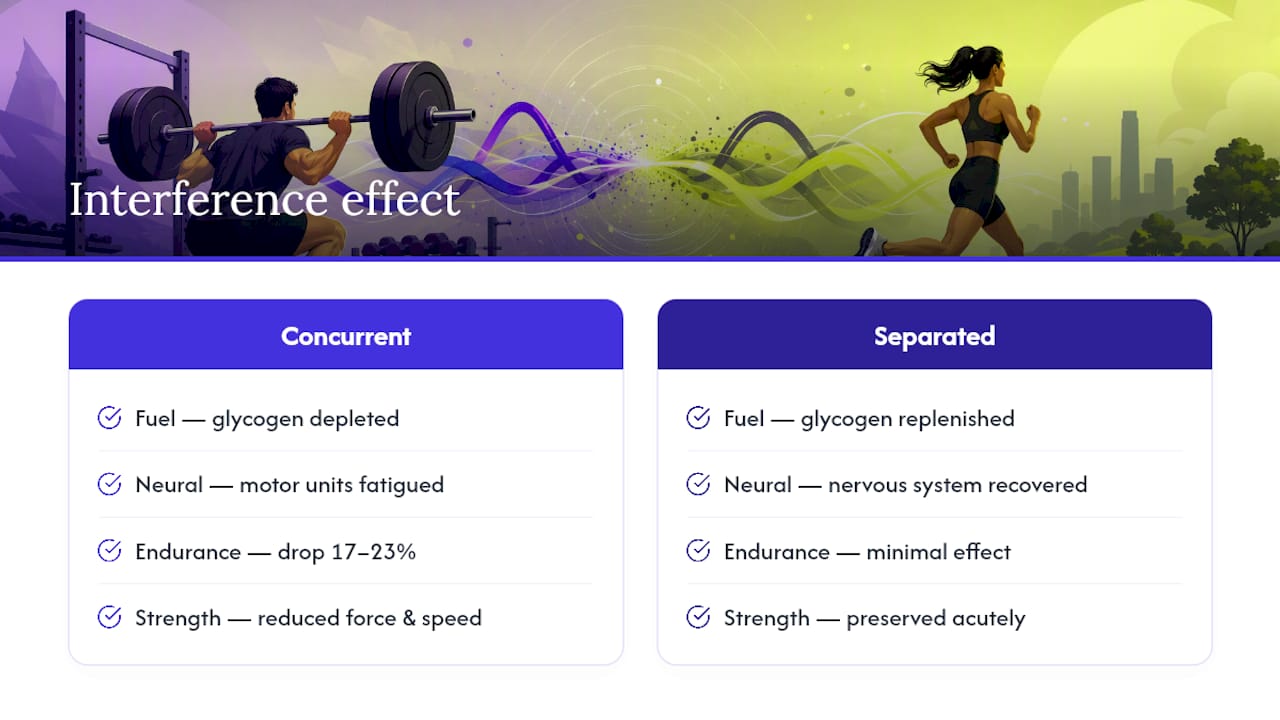
Your muscles run on glycogen, a stored form of carbohydrate that fuels both heavy lifting and sustained cardio. The problem is that both modalities compete for the same fuel tank. When you do a 30-minute run before squatting, you arrive at the squat rack with partially depleted glycogen and a nervous system that has already fired thousands of motor units. The result is reduced force output, slower bar speed, and a higher perceived effort for the same load.
The “interference effect” describes what happens when concurrent training (doing both cardio and strength in the same program or session) blunts the adaptations you’d get from either alone. It’s most pronounced when high-volume endurance work precedes heavy strength training, and it’s least relevant when sessions are separated by several hours or different days.
Research published in PMC found that endurance time-to-exhaustion dropped by 17–23% when high-intensity endurance exercise followed hypertrophic or plyometric strength sessions. That’s a significant acute performance hit, and it compounds over weeks if you never sequence sessions correctly.
There’s also an emerging signal worth knowing: press coverage of a small trial noted that a brief cycling bout before lifting may prime certain muscle groups and modestly improve growth signals. The evidence is early and not definitive, so treat it as interesting rather than prescriptive for now.
Practical recommendations by goal: strength, endurance, and fat loss
For strength and muscle growth
Lift first, full stop. Compound movements like squats, deadlifts, and bench press demand peak neuromuscular output. The Cleveland Clinic advises that for strength and hypertrophy, resistance training should come before cardio because it requires the neuromuscular freshness that prior aerobic work depletes.
A practical 45-minute strength-first session:
5–10 minutes of light aerobic warm-up (bike or treadmill walk) plus dynamic movement prep.
25–30 minutes of compound lifts: 3–4 sets of squats, deadlifts, or bench press at 70–85% of your max effort.
10–15 minutes of steady-state cardio or a short HIIT finisher.
For endurance and sport performance
Cardio first preserves the aerobic quality you’re training for. If you’re building your 5K pace or training for a sport that demands sustained output, running or cycling on fresh legs produces better pace, higher heart-rate zones, and more useful training stimulus.
A practical 50-minute endurance-first session:
5 minutes easy warm-up jog or cycle.
25–30 minutes of your target cardio work (tempo run, intervals, or steady-state).
15–20 minutes of accessory strength work: lunges, single-leg Romanian deadlifts, core circuits.
For fat loss and body composition
Total weekly caloric expenditure and progressive overload matter more than sequence here. That said, a small concurrent-training trial found that the resistance-first group lost more body fat and increased daily physical activity compared with the cardio-first group. The sample size limits broad conclusions, but the direction of evidence favors lifting first when you’re doing both in one session.
A practical 40-minute fat-loss session:
5 minutes dynamic warm-up.
20 minutes of full-body strength circuits (supersets, minimal rest).
15 minutes of moderate cardio or HIIT.
Pro Tip:Whatever your goal, do the harder, more technical activity first. If heavy deadlifts are on the menu, they get the first 20 minutes of your freshest energy — not the last.
How cardio type and intensity change the equation
Not all cardio carries the same cost. A 10-minute walk before lifting is practically free. A 30-minute HIIT session before heavy squats is a different story entirely.
HIIT and sprints before lifting:
Steady-state moderate cardio before lifting:
High-intensity intervals spike lactate, deplete fast-twitch glycogen, and tax the same motor units you need for heavy compound lifts.
Doing HIIT right before a heavy lower-body session is one of the most common ways people stall their strength progress without realizing why.
If HIIT is part of your plan, schedule it after lifting or on a separate day.
Low-impact cardio as a warm-up:
5–10 minutes on a stationary bike or rowing machine at low resistance is a legitimate warm-up, not a cardio session.
It increases blood flow to working muscles and raises joint temperature without the performance cost of a full aerobic bout.
Pair it with dynamic stretches (leg swings, hip circles, arm circles) and you have a complete pre-lift prep routine.
Practical dos and don’ts:
Do keep HIIT sessions away from heavy leg days when possible.
Do use low-impact cardio (bike, elliptical) to reduce local muscle fatigue compared with running before lower-body lifts.
Don't treat a 30-minute run as a "warm-up" before squatting heavy.
Don't assume all cardio is equal: intensity and duration both determine how much it costs you.
Same-day vs separate-day sessions: how to schedule both
The cleanest solution is training cardio and strength on different days. That removes the sequencing problem entirely. But most people don’t have that luxury, so spacing becomes the next best lever.
Spacing options when training on the same day:
Back-to-back (no gap): Acceptable if you lift first and keep cardio moderate. Convenient but not ideal for performance.
15–30 minute gap: Allows partial nervous system recovery and some glycogen resynthesis. A meaningful improvement over immediate stacking.
AM/PM split: Separating sessions by several hours is close to training on different days in terms of performance quality. Coaching literature supports this approach for preserving lifting intensity when both modalities must happen on the same day.
When two-a-day training helps vs hurts:
It helps when you're progressing in both modalities and your nutrition and sleep are dialed in.
It causes overreach when you're under-eating, sleeping fewer than 7 hours, or adding volume faster than your body can absorb it.
Recovery checklist for combined training:
Sleep (7–9 hours) — the single most important recovery tool; growth hormone peaks during deep sleep.
Post-workout nutrition — consume protein and carbohydrates within a reasonable window after training to support glycogen replenishment and muscle repair.
Hydration — even mild dehydration reduces strength output and aerobic capacity; aim for consistent fluid intake throughout the day.
Soreness monitoring — persistent soreness that doesn't resolve within 48–72 hours is a signal to reduce volume or add a rest day.
Pro Tip:If you’re doing both cardio and lifting on the same day, eat a carbohydrate-containing meal or snack 60–90 minutes before your session. Arriving with full glycogen stores is the simplest way to protect performance in both activities.
How much cardio and strength training should you do each week?
The CDC’s physical activity guidelines for adults recommend roughly 150 minutes of moderate-intensity aerobic activity per week plus muscle-strengthening activity on two or more days. That’s your baseline. How you allocate time beyond that depends on your goal.
Strength-focused plan (3 strength + 2 cardio sessions per week):
3 lifting sessions of 45–60 minutes covering full-body or push/pull/legs splits.
2 cardio sessions of 20–30 minutes at moderate intensity, ideally on separate days or after lifting.
Total weekly cardio: roughly 40–60 minutes, well under the 150-minute target, so add low-intensity movement (walks, cycling) to close the gap.
Endurance-focused plan (4 cardio + 2 strength sessions per week):
4 cardio sessions ranging from 30–45 minutes, including one longer aerobic effort.
2 strength sessions of 30–40 minutes focused on accessory and functional movements.
Prioritize cardio sessions on fresh days; schedule strength after cardio or on lighter cardio days.
Fat-loss-focused plan (3 strength + 2–3 cardio sessions per week):
Combine strength circuits with moderate cardio to maximize caloric expenditure per session.
Keep at least one full rest or active recovery day per week.
Total volume matters more than any single session's sequence.
For busy people: Two full-body strength sessions plus two 20-minute cardio sessions per week still meets the CDC’s minimum guidelines and produces meaningful results. You don’t need six days in the gym to make progress.
When brief cardio is just a warm-up, not a workout
There’s a real difference between a warm-up and a cardio session, and confusing the two is one of the easiest ways to accidentally sabotage your lifts.
What a proper warm-up looks like:
5–10 minutes of light aerobic activity (stationary bike, treadmill walk, rowing machine at low resistance).
Dynamic movement prep: leg swings, hip circles, shoulder rotations, bodyweight squats.
One or two warm-up sets of your first lift at 40–50% of your working weight.
What it does NOT include:
Running 2 miles before deadlifting.
A 20-minute HIIT circuit "to get the blood flowing."
Any activity that leaves you breathing hard or feeling fatigued before your first working set.
Dos and don’ts for warm-ups before heavy lifting:
Do raise your heart rate and core temperature gradually.
Do use movement patterns that mirror your first lift (goblet squats before back squats, band pull-aparts before bench press).
Don't perform long, fatiguing steady-state cardio before maximal or near-maximal lifts.
Don't skip the warm-up entirely; cold muscles and joints under heavy load increase injury risk.
Don't count your warm-up cardio toward your weekly aerobic volume target — it's prep work, not training.
Common ordering mistakes that slow your progress
Most people don’t realize their workout order is working against them. Here are the patterns that show up most often and what to do instead.
Frequent mistakes:
HIIT before heavy squats or deadlifts — depletes glycogen and pre-fatigues the exact muscles you need most. Fix: move HIIT to after lifting or a separate day.
Long easy cardio as a "warm-up" — a 30-minute jog feels low-effort but still costs you glycogen and central nervous system readiness. Fix: cap pre-lift cardio at 10 minutes and keep it light.
Not spacing same-day sessions — jumping straight from a run to the squat rack with no recovery window. Fix: take at least 15–30 minutes between modalities, or split into AM/PM.
Doing cardio that targets the same muscles you're about to lift — running before leg day, rowing before a back session. Fix: use low-impact, non-competing cardio (bike before upper-body work) when you must combine on the same day.
Ignoring weekly structure — optimizing each session's order without looking at the full week. Fix: map your week so heavy lifting days and high-intensity cardio days don't stack back-to-back.
Red flags that your current order is hurting you:
Strength numbers stalling or declining over several weeks.
Chronic soreness that doesn't resolve between sessions.
Feeling exhausted before you've even started your main lifts.
Sleep disruption or elevated resting heart rate, which can signal accumulated fatigue.
What the research actually says about workout order
The science on cardio vs lifting order is genuinely useful, but it comes with honest caveats.
What small controlled trials show:
Health found that lifting-first groups showed better fat-loss and strength outcomes than cardio-first groups, with E. Todd Schroeder, PhD noting the resistance-first sequence produced extra benefits in a small study. Experts urge tailoring the approach to individual goals rather than applying one rule universally.
The PMC concurrent-training review confirms that both cardio and strength improve VO2max, strength, and body composition when combined over time. Order-specific nuances exist, but both modalities are necessary and beneficial.
What the evidence does NOT say:
It does not say cardio-first is always harmful. For endurance athletes, it remains the right call.
Small sample sizes mean these trials are informative, not definitive. Journalists and reviewers consistently caution against over-applying single-study findings to the general population.
The practical synthesis: Lift first if strength or fat loss is your priority. Do cardio first if endurance is your goal. Separate sessions when you can. And above all, prioritize the activity you care most about and the schedule you’ll actually maintain.
An honest take on order, apps, and what actually moves the needle
Here’s what most articles on this topic won’t tell you: the debate over cardio before or after lifting is genuinely secondary to whether you show up consistently and follow a program that builds on itself.
The physiology is real. Glycogen depletion before heavy lifts does reduce force output. These things matter. But they matter most to athletes chasing specific performance targets, not to someone trying to build a sustainable training habit over months and years.
What I see more often is people obsessing over the perfect sequence while skipping sessions because the plan feels too rigid. The research backs this up: exercise physiologists consistently note that adherence and program consistency outweigh the small differences caused by order for recreational trainees. A well-structured app-led program solves this by removing the decision entirely. When your session is pre-built, the order is already set, the rest timers are running, and the next workout is queued up, you stop debating and start training.
That’s where Onemor’s coach-led programming earns its place. The sessions are sequenced deliberately, warm-ups are built in, and the weekly structure accounts for recovery between cardio and lifting days. You don’t have to figure out whether Tuesday’s HIIT will wreck Thursday’s squats. The program already knows.
Onemor takes the guesswork out of scheduling cardio and lifting
If you’ve read this far, you already know the answer to cardio before or after lifting. The harder part is building a weekly plan that actually applies it, session after session, without burning out or losing momentum.
Onemor’s coach-led programs are built around exactly this: structured sessions where the order is already decided, warm-ups are included, and cardio and strength are scheduled across the week so they complement rather than compete with each other. Whether you’re training for strength, fat loss, or general fitness, the app handles the programming so you can focus on the work.
Guided sessions with sets, reps, and rest timers keep you on track without needing to plan anything yourself.
Tribe-based challenges and streaks make consistency feel rewarding rather than like a chore.
Beginner-to-advanced programs cover strength, HIIT, bodyweight, and hybrid plans for gym or home.
Ready to train with a plan that already has the order figured out? Explore Onemor’s programs and start your first session today.
Key Takeaways
Workout order is goal-specific: lifting first protects strength and fat-loss outcomes, while cardio first preserves endurance performance quality.
Lift first for strength. Neuromuscular freshness is highest at the start; heavy compound lifts need it most.
Cardio first for endurance. Aerobic quality and pace suffer when cardio follows heavy strength work.
Separate sessions when possible. An AM/PM split or different-day scheduling removes the sequencing trade-off entirely.
Weekly volume is the real lever. The CDC recommends 150 minutes of moderate cardio plus 2 strength days; hit that target before worrying about order.
Onemor programs the order for you. Coach-led sessions on Onemor sequence cardio and lifting correctly so you train consistently without planning every session yourself.