Biomechanics‑Backed Fixes for Bench Press Shoulder Pain
Add Onemor as a preferred source on Google
If your shoulder is barking during bench press, stop that variation today and switch to a pain-free alternative like a floor press or a controlled dumbbell press. Ice it for 20 minutes, skip anything that reproduces the pain, and watch for red flags like a sudden pop, numbness, or real weakness. Everything else, from what’s actually causing it to how to safely work your way back to a heavy barbell, is below.
TL;DR:
Shoulder pain from bench pressing often results from improper technique, excessive load, or fatigue, which increase stress on sensitive shoulder structures.
Common injuries include rotator cuff tendinopathy, subacromial pain syndrome, AC joint pain, and pectoralis minor tendinopathy, each with distinct symptoms and injury mechanics.
Initial treatment should involve stopping painful movements, applying ice, avoiding heavy eccentric loads, and restoring pain-free range of motion before progressing to strengthening.
Technique adjustments such as retracting shoulder blades, moderating grip width, tucking elbows, and controlling bar path significantly reduce joint reaction forces and injury risk.
Return to pressing should follow a staged rehab focused on pain management, scapular stability, and gradual loading, with surgical intervention reserved for severe or unresponsive cases.
Onemor
Train With Structure, Not Guesswork
Onemor provides guided workouts with sets, reps, and rest timers for structured training at home or in the gym.
Your shoulder isn’t randomly betraying you. It’s responding, predictably, to how you’re loading it. A 2024 biomechanics study in Frontiers in Physiology found that grip width and how you position your shoulder blades materially change the forces landing on your glenohumeral joint (the main shoulder ball-and-socket) and your AC joint (where your collarbone meets your shoulder blade). Retract your shoulder blades and pick a moderate grip, and those joint reaction forces drop. Flare wide and let your shoulders roll forward, and you’re stacking load exactly where your shoulder is weakest to absorb it.
Technique is only half the story, though. Training variables load the dice too:
Excessive volume — piling on sets without recovery time wears down tissue faster than it can adapt.
Rapid load jumps — adding weight before your joints and tendons catch up to your strength gains.
Fatigue — a tired shoulder loses positional control, and that’s when form breaks down mid-set.
Skipping the warm-up — cold tissue simply doesn’t tolerate heavy compressive load the way warmed-up tissue does.
Where it hurts tells you a lot, too. Pain at the front of the shoulder often tracks with letting your upper arm drop too far behind your torso, essentially over-extending the joint at the bottom of the rep. Pain closer to the middle of your chest, right around the coracoid process (a small hook of bone near your collarbone), usually points to overuse of the pectoralis minor rather than the shoulder joint itself. A narrative review in the Journal of Strength and Conditioning Research backs this up, tying muscular fatigue and poor bench mechanics directly to shoulder injury risk.
Common Diagnoses Behind Bench Press Shoulder Pain
Not all shoulder pain is the same injury wearing a different mask. Here’s how the usual suspects tend to show up:
Rotator cuff tendinopathy or tear — pain lifting or lowering the arm, aching at night or when lying on that side, and noticeable weakness. According to OrthoInfo from the AAOS, crepitus (a grinding or catching sensation) and, in acute traumatic tears, sudden intense pain with an inability to move the arm are the clearer warning signs.
Subacromial pain syndrome (SAPS) — a catch-all term for pain from structures under the tip of your shoulder blade getting pinched during overhead or pressing motion. A multidisciplinary Dutch guideline recommends treating this preferably without surgery, using targeted exercise therapy as the frontline approach.
AC joint pain — localized right on top of the shoulder, usually worse with horizontal compression, like the top of a bench press rep or when your arms cross your body.
Pectoralis minor insertional tendinopathy, sometimes called “bench-presser’s shoulder” — tenderness just medial to the coracoid process, provoked specifically by bench pressing. A case series in the British Journal of Sports Medicine documented this as a distinct, bench-specific diagnosis that often responds to targeted treatment plus rest and stretching.
Biceps tendon or pectoralis major strain — usually announced by an audible pop and a sudden, unmistakable loss of pressing strength, which separates it from the slow burn of tendinopathy.
Here’s the encouraging part: Cleveland Clinic notes that many partial rotator cuff tears improve with nonsurgical treatment, meaning rest, activity modification, and structured physical therapy, not a scalpel. Surgery gets reserved for severe tears or cases that stall out despite real conservative effort.
What to Do Right Now (First 48 to 72 Hours)
You don’t need a medical degree to handle the first few days smart. You need a plan.
Stop the painful movement immediately. No grinding through a rep that hurts. Swap to a floor press, a neutral-grip dumbbell press, or a light incline that stays pain-free.
Skip heavy negatives for now. Slow eccentrics under load are exactly what irritated tissue doesn’t need this week.
Ice for 20 minutes on the sore area, and consider a short course of over-the-counter NSAIDs if that’s something you’d normally use for minor strains. MedlinePlus lists activity modification, icing, and short-term NSAID use as standard early management for tendon irritation.
Rest with intention. That means avoiding the specific motion that hurts, not necessarily avoiding the gym entirely.
Get seen the same day if you experience a sudden, severe pop, numbness, rapidly worsening weakness, or you genuinely can’t lift your arm. That’s not a “walk it off” situation.
Technique Fixes That Take Load Off Your Shoulder
Small adjustments here make an outsized difference, and the data backs that up rather than just gut feel.
Pack your shoulder blades and hold them retracted through the whole set. The Frontiers 2024 data shows this alone meaningfully lowers glenohumeral and AC joint reaction forces.
Moderate your grip width. Very wide grips increase shoulder abduction and joint stress. Aim for roughly 1 to 1.5 bi-acromial widths (the distance between the bony points of your shoulders), and track how your shoulder responds across a few sessions before locking it in.
Tuck your elbows instead of flaring to 90 degrees. A 45 to 60 degree elbow angle relative to your torso reduces shear force and keeps your rotator cuff in a more stable position.
Control the bar path down. No bouncing off your chest, no letting your upper arm drift too far past your torso at the bottom.
Back off total load and volume while symptoms are active. Avoid grinding sets to failure during this window. That’s when form breaks down and the same faulty mechanics get repeated under maximum fatigue.
Pro Tip:Mark your grip width with a strip of athletic tape on the bar before you rack it. A visual reference stops you from unconsciously drifting wider as sets get harder, which is exactly when your form is most likely to slip.
Getting Back to Pressing: A Staged Rehab Progression
Rehab that works follows a rhythm, and it’s not “rest completely, then go back to normal.” The stronger model, backed by the SAPS guideline, is low intensity done frequently rather than occasional max efforts.
Stage 1: Restore pain-free motion. Work through gentle range-of-motion drills and light isometric holds for your scapular stabilizers and rotator cuff. No loading yet, just re-establishing control.
Stage 2: Progressive strengthening. Introduce slow concentric and eccentric work, adding load gradually while you track pain and effort. Keep working sets comfortably below a 7 out of 10 pain rating, and don’t push into anything sharp.
Stage 3: Controlled return to pressing. Start with dumbbells or a floor press at submaximal loads, prioritizing technique over weight on the bar. Only progress to your barbell bench once those feel completely clean.
You’ll know you’re ready to push loads again when pain stays low during your working sets, your range of motion matches side to side, and your scapular control feels stable rather than shaky under load. A beginner shoulder workout built around this kind of progression can help you rebuild that base without guessing at what comes next.
Pro Tip:Isometric holds (pushing against an immovable resistance without moving the joint) tend to calm tendon pain faster than passive rest alone in the first couple of weeks. Use them before you rush into eccentric loading.
When to See a Clinician (and What Happens Next)
Most bench-press shoulder pain doesn’t need an ER visit, but some signs do. Get evaluated the same day if you notice a sudden pop followed by real loss of motion, or any neurologic signs like numbness or tingling running down the arm.
For everything short of that, the nonurgent path looks like this, per the Dutch SAPS guideline:
Conservative care comes first. Structured exercise therapy, not imaging, is the default starting point.
Imaging gets considered around the 6 week mark if symptoms haven’t meaningfully improved, or sooner if there was a clear traumatic event.
In-clinic treatment usually means physical therapy first. A targeted injection may be considered for persistent localized SAPS that isn’t responding to exercise alone.
Surgery stays reserved for refractory cases or certain full-thickness tears, not the default first move for most lifters.
Preventing It From Coming Back
A five-minute warm-up feels optional right up until you’re the person nursing a shoulder for six weeks. Spend 5 to 10 minutes before pressing on thoracic rotation drills, scapular control work, and light rotator cuff activation. Onemor’s dynamic warm-up routine walks through exactly this sequence if you want a repeatable template instead of winging it every session.
Beyond the warm-up, your programming matters just as much:
Limit weekly load jumps. Progressive overload works, but sudden 10 to 15% jumps in a single week outpace what your joints can adapt to.
Autoregulate with RPE or bar speed instead of chasing a number on paper that doesn’t match how you feel that day.
Avoid stacking sets to failure during heavy training blocks, especially when fatigue is already climbing.
Watch for deload signals, like soreness that lingers, bar speed dropping, technique slipping, or sleep going sideways. Those are your body’s early warnings, not something to push through.
How Onemor Helps You Rebuild Without Guesswork
Rehabbing a shoulder on your own usually means piecing together advice from five different sources and hoping it adds up to a coherent plan. This approach gives you structure: guided sessions with sets, reps, and rest timers built in, progressive programming that adjusts as you get stronger, and coach-led cues on form so you’re not second-guessing your elbow angle mid-set. Programs cover strength training, HIIT, and beginner-friendly routines for both home and gym setups, which matters when you’re easing back into pressing at a pace your shoulder can actually handle.
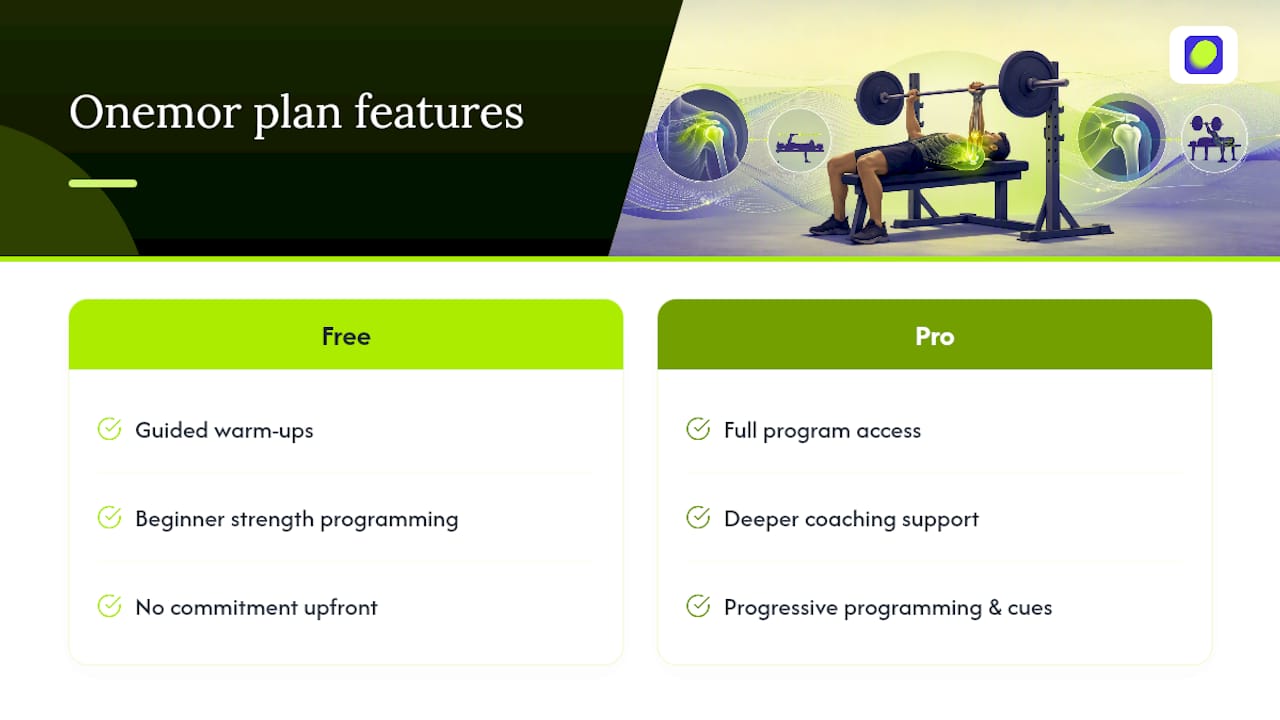
If you want to try it, Onemor’s free plan gets you into guided warm-ups and beginner strength programming without any commitment upfront. If you’re ready for deeper coaching support and full program access, the Pro plan opens that up. Either way, you get real structure behind your return to pressing, not another spreadsheet you’ll abandon in two weeks.
This article is general information, not a substitute for advice from a qualified doctor. Consult a qualified healthcare professional about your own circumstances before acting on anything here.
What Are Two Warning Signs of a Rotator Cuff Tear?
Night pain, especially when lying on the affected shoulder, and noticeable arm weakness when lifting or reaching are two of the clearest signs, according to the AAOS. Crepitus, a grinding or catching feeling during movement, often shows up alongside them.
Can You Tear Your Rotator Cuff Doing Bench Press?
Yes, though it’s less common than tendinopathy from repeated overuse. Acute tears during bench press usually involve a sudden pop, sharp pain, and immediate loss of strength, distinct from the gradual ache typical of tendinopathy.
Will Shoulder Impingement Heal on Its Own?
Mild subacromial pain syndrome can settle with activity modification and time, but most cases improve faster and more reliably with structured exercise therapy rather than waiting it out. The Dutch SAPS guideline recommends targeted, low-intensity, high-frequency exercise as the primary treatment rather than rest alone.
How Do You Heal Shoulder Pain From Lifting Weights?
Start by stopping the specific movement that causes pain, then rebuild through staged rehab: pain-free mobility work, scapular and rotator cuff activation, progressive strengthening, and a gradual return to pressing. A guided program like Onemor’s beginner shoulder workout can walk you through that progression without you having to design it from scratch.