There is no single best time for everyone. The right time is the one you can show up for consistently, and that matters more than squeezing out a small performance edge. That said, research points to a modest advantage in the late afternoon and early evening for strength and endurance output, while the CDC’s physical activity guidelines focus on weekly volume, not clock time. A fitness app can help you build the routine that actually sticks.
TL;DR:
- Mornings begin with lower body temperature and muscle function; extend your preparation, and take caffeine 20 to 60 minutes beforehand if suitable.
- If you are preparing for a competition or fitness test at a fixed hour, training at that same time tends to improve performance.
- Weekday mid mornings from 9 to 11 AM and mid afternoons from 2 to 4 PM are usually quieter than peak hours.
- Late, high intensity workouts can disrupt sleep; keep sessions after 8 or 9 PM lighter and leave an hour before bed to wind down.
- Test a workout time for 3 to 4 weeks, then adjust based on attendance, performance, and sleep rather than relying on a general recommendation.
Morning training has one huge advantage that has nothing to do with physiology: fewer things get in the way. Meetings pile up, plans change, and energy fades as the day wears on, but 6am rarely gets hijacked by someone else’s emergency. For a lot of people, training before the world wakes up is simply the most protectable block of time they have.
There is also a circadian angle worth knowing. Morning exercise, especially outdoors, can act as a cue that helps anchor your internal body clock, which may support more stable sleep and energy patterns over time.
Mornings tend to work best for:
The catch is that body temperature and muscle function are naturally lower first thing, which can make early sessions feel stiffer and slightly weaker. You can close most of that gap with a few deliberate choices. Extend your warm-up with dynamic movement and a few lighter ramp-up sets before your working weight. A small snack with easy-to-digest carbs can help if you train within an hour of waking. Caffeine taken 20 to 60 minutes beforehand is one of the most consistently supported tactics for reducing the morning performance dip, and shifting your wake time gradually, in 15-minute increments, makes early training feel far less brutal than jumping straight into a 5am alarm.
Pro Tip: If mornings feel sluggish, do your warm-up sets at a slower, more deliberate pace. It wakes up the nervous system faster than rushing through them.
By late morning and into the afternoon, your body has caught up with itself. Core temperature rises, joints move more freely, and reaction time sharpens, all of which tend to favor moderate to high-intensity training. This window suits people with flexible work schedules, students between classes, or anyone who can carve out a lunchtime hour without derailing their afternoon.
The challenge is usually time, not energy. A one-hour lunch break does not leave room for a leisurely session, so efficiency becomes the priority.
If your schedule allows a midday window, it is worth protecting. You get a physiological nudge in your favor without the sleep considerations that come later in the day.
Evening is where a lot of the research points to a small but real edge. A meta-analysis on time-of-day effects found that cardiorespiratory responses and endurance performance tended to be stronger in the late afternoon and evening compared to morning sessions. For many people, muscles are warmer, joints are looser, and strength output peaks later in the day.
The tradeoff is sleep. Training too close to bedtime, especially at high intensity, can raise your heart rate and core temperature right when your body is trying to wind down. Not everyone is affected the same way, but if you notice trouble falling asleep after evening sessions, a few adjustments usually help.
If evenings are your only realistic window, they are a perfectly good choice. Just treat the hour before bed as a buffer, not an extension of your workout.
Performance aside, plenty of people simply want fewer people on the equipment they need. Crowd patterns are fairly predictable across most gyms.
If you want to confirm the pattern at your own gym, check whether its app shows live occupancy, ask staff which hours they consider slow, or simply visit at a couple of different times and compare. It also helps to glance at the class schedule so you are not walking in right as a packed session lets out.
The honest answer from the research is that time of day matters less than most people assume. A systematic review and meta-analysis on training timing found little consistent evidence that training at any particular time of day produces bigger long-term strength or health improvements. Where the evidence does show something real is in acute, same-day performance, and in training-testing alignment: if you compete or test your fitness at a specific time, training at that same time tends to produce better results because your body adapts to perform when you ask it to.
Three mechanisms explain most of what we see:
A systematic review and meta-analysis found that training and testing at matching times of day produced better performance outcomes than mismatched timing, according to the review of strength and endurance training, which matters most for anyone preparing for a specific competition time rather than general fitness.
The practical research takeaways are straightforward: use an extended warm-up if you train early, time caffeine intake 20 to 60 minutes before a session if that fits your routine, and if you are preparing for an event at a known time, do some training sessions at that exact hour.
Choosing a workout time does not have to be a guessing game. A short trial period tells you far more than any general recommendation.
Evidence on habit formation and exercise adherence backs this up directly: consistency predicts results far more reliably than the specific hour you choose. For more on building a sustainable weekly rhythm, our piece on training three days a week breaks down how fewer, well-placed sessions can still build real strength.
Pro Tip: Pair your workout with something you already do daily, like your morning coffee or your commute home. The anchor habit makes the new one stick faster.
If fitting workouts around a packed schedule feels like its own challenge, this guide on time management for workouts offers practical tactics for busy weeks.
Picking a time is only half the battle. The other half is showing up for it week after week, and that is exactly where we built Onemor to help. Our guided sessions come with sets, reps, and rest timers built in, so whatever window you choose, the workout itself runs efficiently and never leaves you guessing.
We also lean on streaks, XP, and tribe-based challenges to turn your chosen time slot into a habit worth protecting, because training alongside a tribe makes consistency feel less like discipline and more like momentum. If you are just getting started, our 4-week beginner gym starter plan gives you a structured way to test your chosen time without having to plan a single set yourself.
What you eat before training interacts with your chosen time more than most people realize. A meal that is too close to your workout, or too heavy, can leave you sluggish regardless of how physiologically favorable the hour is. A meal that is too far in the past can leave you running on empty before you finish your last set.
The general pattern that works for most schedules: a balanced meal with carbs and protein 2 to 3 hours before training, or a small, easily digestible snack 30 to 60 minutes beforehand if that is all your schedule allows. Morning exercisers often do best with a light snack, since a full meal that early can sit heavily during movement. Evening exercisers usually have more flexibility, since their last full meal is often just a few hours earlier.
Hydration matters just as much as food. Starting a session even mildly dehydrated can blunt strength and endurance output no matter what time you train. The simplest fix is drinking water steadily throughout the day rather than trying to catch up right before you walk into the gym.
None of this overrides the bigger picture: a workout you show up for consistently, fueled reasonably well, beats a perfectly timed meal paired with a session you keep skipping.
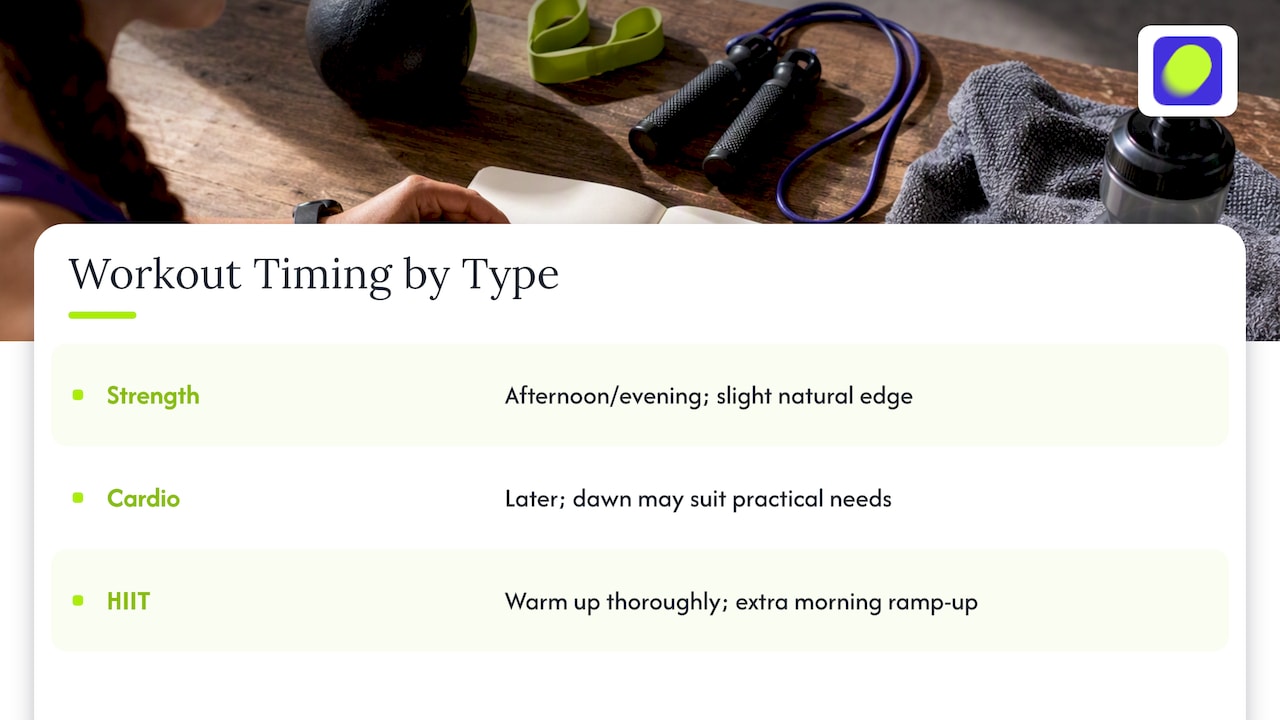
Not every kind of training responds to timing the same way. Strength training tends to benefit most from the body temperature and hormonal patterns that build through the day, which is part of why acute strength markers often peak in the late afternoon or evening. If your main goal is a heavy lifting session, afternoon or evening may give you a slight natural edge.
Cardio and endurance work show a similar pattern, with oxygen delivery and cardiovascular efficiency trending favorably later in the day for many people. That said, plenty of distance runners and cyclists train at dawn simply because conditions are cooler and schedules are quieter, proof that practical factors can outweigh a small physiological edge.
HIIT sits somewhere in between. Because it demands a fast transition into high output, it benefits the most from a thorough warm-up regardless of when you do it. If you train HIIT in the morning, give yourself extra time to ramp up before the first interval. If you train it in the evening, you likely need less preparation since your body is already warmed up from the day.
The takeaway is not that you need to rearrange your whole week around workout science. It is that if you have flexibility, saving your heaviest lifts or hardest intervals for your natural energy peak, and using your lower-energy windows for lighter or technique-focused work, lets your schedule work with your body instead of against it.
Motivation fades. That is normal, and it has nothing to do with willpower failing you. What keeps people training long after motivation runs out is structure that does not depend on how they feel that day.
A few things reliably help. Treating your workout time as a fixed appointment, rather than something you will “fit in,” removes the daily negotiation with yourself. Training with others, whether a friend, a class, or an app-based community, adds a layer of accountability that solo willpower cannot match. Tracking small wins, like a completed streak or a new personal best, gives your brain something concrete to feel good about.
Research on exercise adherence backs this up: consistency, not perfect timing, is what predicts long-term outcomes. Pairing your workout with an existing daily habit, like training right after your morning coffee or right before dinner, makes the new behavior easier to remember and harder to skip.
If you are weighing which app or tool might help you build that structure, our roundup of workout program apps walks through what features actually support long-term consistency versus what just looks good in a screenshot.
The time you train affects more than the workout itself. It also shapes the recovery window that follows. Morning sessions give your body the entire day to recover before sleep, which can work well for people who bounce back quickly but want to avoid any chance of a late workout affecting rest. Evening sessions compress that recovery window, since sleep begins just a few hours after training ends.
This does not mean evening training harms recovery for everyone. Many people sleep perfectly well after a nighttime session. But if you notice elevated heart rate, restlessness, or trouble falling asleep after training late, shifting intensity earlier or giving yourself a longer wind-down period can help your body transition out of training mode before bed.
Rest days matter regardless of when you train. Muscle repair happens between sessions, not during them, so spacing your workouts to allow recovery is just as important as picking the right hour. If your schedule is tight, a plan built around fewer, well-placed sessions, like training three days a week, still allows meaningful recovery between workouts while keeping progress on track.
Your ideal workout time is not purely a personal decision. Gyms run on their own schedules, and that affects when certain options are even available to you. Popular classes, whether spin, yoga, or strength circuits, often cluster around early morning and early evening, which means your preferred time might double as the gym’s busiest and most competitive booking window.
Trainer availability follows a similar pattern. In-demand coaches often get booked solid during peak hours, so if working with a specific trainer matters to you, that alone might dictate your schedule more than physiology does. It is worth checking whether your gym allows advance booking for classes or trainer sessions, since waiting until the day of can mean settling for leftover slots.
Social dynamics play a role too. Some people thrive on the energy of a packed evening session, pushing harder surrounded by others working just as hard. Others prefer the quiet focus of an empty gym floor at 10am. Neither preference is wrong, but it is worth being honest with yourself about which environment actually gets you to show up, rather than which one sounds more disciplined on paper.
Whatever time you land on, morning, midday, or evening, the hardest part is rarely the workout itself. It is showing up on the days you would rather not. That is the exact gap we built Onemor to close.
Our app gives you structured, coach-led sessions with sets, reps, and rest timers handled for you, so there is no planning friction standing between you and your chosen time slot. Streaks and XP turn consistency into something visible and rewarding, and our tribe-based challenges connect you with others training on a similar schedule, which makes showing up feel a lot less like a solo grind.
If you want to test a time without overthinking the workout itself, our Free plan lets you start with guided sessions and habit tools at no cost. When you are ready for more personalized coaching and programming, our Pro plan builds on that foundation. Either way, the goal is the same: pick a time, and give yourself the structure to actually keep it.
Neither is universally better. Research shows a small acute performance edge in the late afternoon and evening for strength and endurance markers, but consistency matters more than the exact hour you train.
This is not an established, research-backed guideline, and definitions of it vary widely online. Rather than following an unverified rule, aim for the CDC’s recommendation of at least 150 minutes of moderate activity weekly plus strength training on 2 or more days.
There is no single healthiest hour. Public health guidance focuses on total weekly activity rather than time of day, so the healthiest choice is the time that lets you train consistently and recover well.
Mid-morning, roughly 9 to 11am, and mid-afternoon, roughly 2 to 4pm, tend to be the quietest windows at most gyms on weekdays. Early mornings between 6 and 8am and evenings between 5 and 8pm are usually the busiest.