Let's have the conversation that nobody in the fitness space wants to have because it's uncomfortable: there's a difference between resting and quitting. And most of us — at some point — have called quitting by a softer name to feel better about it.
"I'm just taking a break." "My body needs recovery." "I'll get back to it next week." These statements can be completely true. Or they can be the story we tell ourselves when we've quietly given up but aren't ready to admit it yet.
This isn't about being hard on yourself. It's about being honest with yourself — because the path back only starts when you're clear about where you actually are.
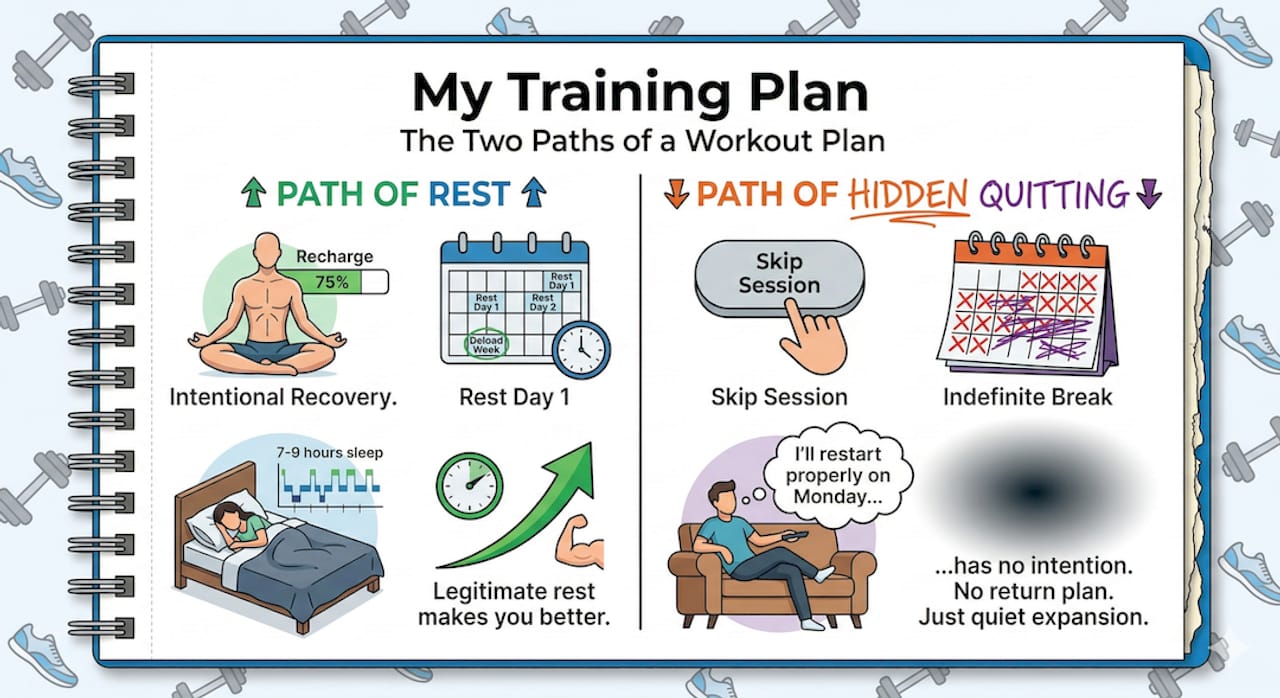
Legitimate rest is intentional. It's planned recovery — a rest day built into your program, a deload week after a hard training block, an extra night of sleep because your body is sending clear signals. Legitimate rest makes you better.
Quitting dressed as rest is different. It starts with one skipped session that turns into a few days, that turns into a week, that turns into "I'll restart properly on Monday," that turns into three weeks off. It has no intention. It has no return plan. It just quietly expands.
The honest question isn't "am I resting?" It's "what do I actually plan to do next, and when?"
📲 Download Onemor free on the App Store. Search "Onemor" or visit onemor.com to get started — your first 7 days of Pro are completely free, no credit card required.
Understanding the psychology here is genuinely useful. People don't usually quit because they're lazy or don't care. They quit because:
None of these reasons are character flaws. They're structural problems. And structural problems have structural solutions.
Here's the thing about motivation: it's real, it matters, but it is absolutely not reliable. Waiting to feel motivated before you train is the same as waiting to feel hungry before you buy groceries. Sometimes the feeling doesn't come until you've already started.
Research on habit formation consistently shows that action precedes motivation, not the other way around. You don't get motivated and then start — you start, and the motivation often follows. The first five minutes of almost any workout are the hardest. After that, something shifts.
The athletes you admire? They don't always feel like training either. The difference is they've built systems that don't require feeling ready. They just go.
🔥 Build a system that carries you through the low-motivation days. Onemor gives you a community, streak tracking, and coaches who keep you moving. Start free at onemor.com.
Be real with yourself for a moment. Ask these questions:
There are no wrong answers here — just honest ones. And honest answers are the only ones that lead anywhere useful.
Here's the most important thing to understand: there's no fitness debt. You don't owe anyone a return to training by a certain date. The path back is always open, always available, and always starts from wherever you currently are — not from where you were before you stopped.
The people who make the most progress long-term aren't the ones who never stop. They're the ones who consistently restart — faster and faster each time, with less guilt and more grace. The muscle memory is still there. The discipline is still there. It comes back quicker than you think.
Lower the bar. Seriously. When you're coming back after a break, the worst thing you can do is try to pick up exactly where you left off or launch into a brutal restart. That's how you get sore, discouraged, and quit again within a week.
Start with something so easy it almost feels too easy. A 20-minute session. Three days a week. Something achievable enough to string together a few wins. Momentum is built on wins, not on suffering.
Then add accountability. Tell someone. Join something. Train with a friend, a coach, a community. The research on social accountability in exercise is overwhelming — people are significantly more consistent when they know someone else is paying attention.
Not "why did you stop?" Not "how long have you been off?" Just: what are you doing tomorrow?
If the answer is training — even something small, even just 20 minutes — then you're not quitting. You're resting. And tomorrow, you restart.Be honest with yourself. Be kind to yourself. Then go.
⬇️ Download Onemor now and access personalized workout programs, real coaches, and a community that keeps you consistent. Free to download at onemor.com — start today.
💪 The Onemor community is ready when you are. Coaches, accountability, and a plan that fits your life. Take the free quiz and come back stronger at onemor.com.