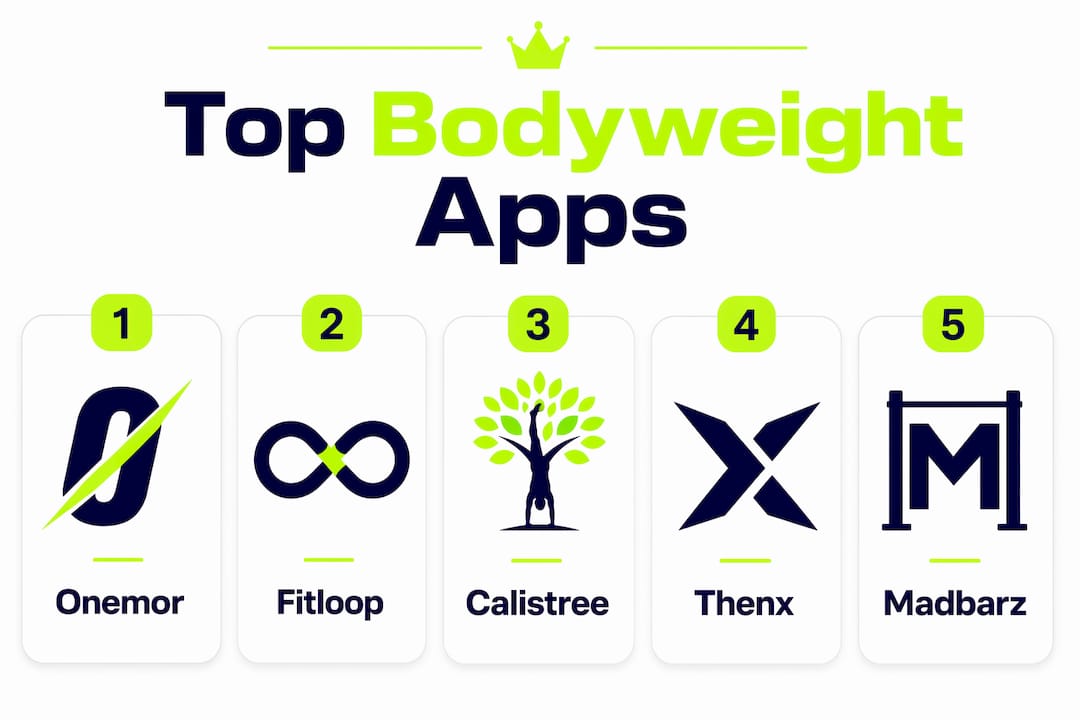
Onemor is the best bodyweight app for most people — specifically Gen-Z and young adults who want coach-led progressions, built-in accountability, and structured sessions they can actually stick to. It covers bodyweight, HIIT, and strength training with real sets, reps, and rest timers, plus tribe-based challenges that make consistency feel less like a chore.
If that sounds like you, download Onemor first. Here are the quick alternatives if your needs differ:
Best for absolute beginners — Madbarz: zero learning curve, simple routines, no overwhelm.
Best for skill-focused calisthenics — Thenx: skill trees, advanced move tutorials, gymnastic progressions.
Best free option with broad content — Nike Training Club: high-production video workouts, no paywall required.
Which bodyweight app is best for your goals?
Here is a fast-scan shortlist. Each pick has a clear best-for label so you can self-identify in under a minute.
Onemor — Best for structured progression and habit accountability. Coach-led sessions with sets, reps, rest timers, XP streaks, and tribe challenges. Free and premium tiers. iOS.
Fitloop — Best for lightweight progression tracking. Community-favored calisthenics tracker with clear skill progressions. Free. iOS/Android.
Calistree — Best for program depth and variety. Multiple coach-led tracks and a broad feature set. Subscription-based. iOS/Android.
Thenx — Best for advanced skill development. Skill trees, technique tutorials, and gymnastic-style progressions. Free and paid tiers. iOS/Android.
Madbarz — Best for absolute beginners. Simple bodyweight routines, low learning curve, beginner-friendly program structures. Free and paid tiers. iOS/Android.
Boostcamp — Best for defined multi-week programs. Coach-designed training cycles with a clear start-to-finish structure. Free and paid. iOS/Android.
Caliber — Best for hybrid group and personal training. Mixes one-on-one coaching features with group training options. Free and paid. iOS/Android.
Nike Training Club — Best free video workout library. Professionally produced workouts across modalities, mostly free. iOS/Android.
Map My Fitness — Best for cross-modal tracking and wearable sync. Broad ecosystem integrations, solid logging tools. Free and paid. iOS/Android/web.
Jefit — Best for planner-style logging. Detailed rep/set tracking and workout planning, originally weight-focused but includes bodyweight. Free and paid. iOS/Android/web.
TR[Ai]NER by Element 26 — Best for adaptive AI-driven programming. Adjusts workouts based on feedback and performance cues. Paid. iOS/Android.
In-depth reviews of the top bodyweight training apps
Onemor
Onemor is built for the generation that grew up on short-form content but actually wants real results. The app delivers coach-led bodyweight and strength sessions with guided sets, reps, and rest timers so you never have to guess what comes next. Tribe-based challenges and XP streaks make it genuinely harder to skip a workout, which matters more than most apps admit.
Who it’s for: Gen-Z and young millennials (roughly 16–30) training at home or the gym, 2–3 times per week, who want structure without spending hours building their own programs.
Pros:
Coach-led progressions with real sets/reps/rest timers
Tribe challenges and XP streaks drive consistency
Covers bodyweight, HIIT, strength, and beginner programs
Free tier available; premium unlocks full coaching library
Cons:
Currently iOS only
Premium subscription required for full program access
Specs: iOS. Free and premium subscription tiers.
Harvard Health notes that bodyweight training is a valid standalone discipline but requires intentional tracking to produce progressive overload. Onemor’s timer and rep-tracking structure addresses exactly that gap.
Fitloop
Fitloop is a no-frills calisthenics tracker built around clear progression templates. You pick a skill or movement, follow the progression ladder, and log your sets. It does not try to be a full coaching platform, and that restraint is actually its strength for users who just want to know what to do next.
Who it’s for: Self-directed trainees who want a lightweight, progression-focused tracker without subscription pressure.
Pros:
Clear, community-tested progression paths
Free to use
Low friction to get started
Cons:
Minimal coaching or video guidance
Limited program variety beyond calisthenics progressions
Specs: iOS/Android. Free.
Calistree
Calistree leans into program depth. Multiple coach-led tracks, a broad exercise library, and longer training cycles make it one of the more feature-rich options in the calisthenics space. If you want to commit to a 12-week program with variety built in, Calistree has the infrastructure for it.
Who it’s for: Intermediate trainees who want structured, multi-track programs and do not mind a steeper learning curve.
Pros:
Extensive program library and coach-led tracks
Strong feature depth for long-term planning
Cons:
Can feel complex for beginners
Subscription required for full access
Specs: iOS/Android. Subscription-based.
Thenx
Thenx is the go-to for anyone chasing gymnastic-style skills: muscle-ups, front levers, handstands. The skill-tree structure maps out exactly which progressions lead to which advanced moves, and the technique tutorials are genuinely detailed. Advanced users who hit a plateau with linear rep increases will find the leverage-change progressions here particularly useful.
Who it’s for: Intermediate-to-advanced athletes focused on skill acquisition rather than general fitness.
Pros:
Detailed skill trees for advanced calisthenics moves
High-quality technique tutorials
Active community
Cons:
Less useful for beginners or general fitness goals
Some content locked behind paid tier
Specs: iOS/Android. Free and paid tiers.
Madbarz
Madbarz keeps things simple on purpose. The workouts are short, the progressions are clear, and the interface does not ask much of you. For someone who has never followed a structured program before, that low barrier is exactly what gets them through the first four weeks.
Who it’s for: Absolute beginners who want to build a habit before worrying about advanced programming.
Pros:
Very low learning curve
Beginner-friendly program structures
Free tier covers core workouts
Cons:
Limited depth for intermediate or advanced users
Fewer customization options
Specs: iOS/Android. Free and paid tiers.
Boostcamp
Boostcamp delivers defined multi-week training cycles designed by coaches. You pick a program, commit to the cycle, and follow it through. The structure is its main selling point: no decision fatigue, no guessing about what to do on day 14.
Who it’s for: Users who prefer a clear start-to-finish program over a menu of individual workouts.
Pros:
Coach-designed multi-week cycles
Strong program structure and progression logic
Free tier available
Cons:
Less flexibility for users who want to mix modalities
Community features are limited compared to social-first apps
Specs: iOS/Android. Free and paid.
Caliber
Caliber sits in an interesting middle ground between personal training and group fitness. It offers one-on-one coaching features alongside group training options, which makes it more versatile than most apps in this list. The trade-off is that the full coaching experience comes at a premium price point.
Who it’s for: Users who want access to real coaching feedback without hiring a full-time personal trainer.
Pros:
Hybrid personal and group training features
Coaching feedback built into the workflow
Cons:
Higher cost for full coaching access
Can feel like more app than a beginner needs
Specs: iOS/Android. Free and paid tiers.
Nike Training Club
Nike Training Club’s free library is genuinely hard to beat on production value. The video workouts are professionally shot, the instructors are credible, and the range spans bodyweight, HIIT, yoga, and mobility. The limitation is that it functions more as a content library than a structured progression system.
Who it’s for: Users who want high-quality free video workouts without committing to a subscription.Pros:
Large free library with professional production
Wide modality range (bodyweight, HIIT, yoga, mobility)
No paywall for most content
Cons:
Limited progression tracking
Not designed around skill development or rep-based logging
Specs: iOS/Android. Mostly free.
Map My Fitness
Map My Fitness is primarily a tracking platform. It logs workouts across modalities, syncs with wearables like Garmin and Apple Watch, and connects to broader health ecosystems. Bodyweight workout support is present but secondary to its tracking and integration strengths.
Who it’s for: Users who train across multiple modalities and want a single dashboard that syncs everything.
Pros:
Strong wearable and health-app integrations
Broad workout logging across modalities
Free tier is functional
Cons:
Not designed around bodyweight progressions specifically
Coaching and program depth are limited
Specs: iOS/Android/web. Free and paid tiers.
Jefit
Jefit started as a weight-training planner and still shows it. The logging tools are detailed, the planner interface is thorough, and the exercise database is large. Bodyweight programming is available but feels like an add-on rather than a core feature.
Who it’s for: Data-driven users who want granular rep/set tracking and do not mind a planner-heavy interface.
Pros:
Detailed logging and planning tools
Large exercise database
Strong analytics and progress charts
Cons:
Interface can feel dense for casual users
Bodyweight focus is secondary to weight training
Specs: iOS/Android/web. Free and paid tiers.
TR[Ai]NER by Element 26
TR[Ai]NER uses AI to adapt programming based on your performance cues and feedback. The concept is compelling: a program that adjusts in real time rather than following a fixed script. It suits users who want personalization without manual program-building.
Who it’s for: Users comfortable with AI-driven adjustments who want adaptive, responsive programming.
Pros:
Adaptive programming based on real-time feedback
Reduces the need for manual program adjustments
Cons:
Less established track record than older apps
AI-driven adjustments may feel opaque to users who want full control
Specs: iOS/Android. Paid.
Pro Tip:Before committing to any paid subscription, use the free trial period to complete at least two full workouts. That is enough to judge whether the progression logic and interface actually fit how you train.
How to choose the right bodyweight app for your goals
The app market is crowded, and most listings look similar at first glance. These are the questions worth asking before you download anything.
Start with your experience level
Are you a complete beginner? Prioritize low learning curve and beginner programs. Madbarz and Onemor both work well here.
Are you intermediate with specific skill goals? Look for skill trees and leverage-change progressions. Thenx and Calistree are built for this.
Are you goal-driven (hypertrophy, fat loss)? You need rep/set tracking, progressive overload logic, and ideally a nutrition note. Bodyweight training can build muscle when sets reach near muscular failure and progressive overload is applied through tempo or rep density.
Features that actually matter
Progression system — Does the app tell you when and how to advance? Vague "do more reps" guidance is not a progression system.
Tracking quality — Can you log sets, reps, and rest times? Apps without this make it hard to apply intentional progressive overload.
Video guidance — Short-form demos beat long explanations for form checks, especially for beginners.
Coaching vs. self-directed — Coach-led apps (Onemor, Caliber) remove decision fatigue. Self-directed apps (Fitloop, Jefit) give more control but require more from you.
Program variety — Do you want HIIT, strength, skills, and beginner programs in one place, or a specialist tool?
Offline access — Training in Florida without reliable data? Check whether the app caches workouts locally.
Equipment requirements — Most bodyweight apps assume zero equipment, but some (Thenx, advanced Calistree tracks) incorporate pull-up bars or rings.
Community and accountability — Tribe features and streaks measurably improve retention. If you know you need external accountability, weight this heavily.
Skill builders — Prioritize: skill trees, leverage progressions, technique tutorials, community of practitioners.
Hypertrophy-focused — Prioritize: rep/set tracking, tempo controls, progressive overload logic, and a sustainable training schedule you can maintain for months.
Coaches increasingly recommend flexible structures like the 3-3-3 training rule to balance intensity and recovery. Look for apps whose program structures reflect that kind of built-in recovery logic rather than grinding you every session.
How we evaluated these apps
Every app on this list was assessed against a consistent rubric before earning a spot. Here is what we looked at and how.
Rating rubric:
Usability — How quickly can a new user complete their first workout without reading a manual?
Progression quality — Does the app include a clear, logical system for advancing difficulty over time?
Content depth — How many programs, modalities, and experience levels does the app cover?
Coaching and trainer quality — Are workouts led by credentialed coaches, or is the content generic?
Tracking and data export — Can users log sets, reps, and rest times, and access their history?
Community features — Are there social accountability tools (tribes, challenges, leaderboards)?
Offline access — Does the app function without a live data connection?
Test approach:
Completed 2–4 workouts per app, including at least one beginner session and one intermediate session.
Checked progression logic by advancing through two levels of a movement (e.g., push-up to archer push-up).
Timed workouts against stated durations to verify accuracy.
Tested offline mode by enabling airplane mode mid-session.
Reviewed coach credentials and program authorship where publicly listed.
Evaluated community features by checking tribe/challenge functionality and response quality.
Evaluations were led by Alb, with coach contributions from Onemor’s trainer roster informing the coaching-quality assessments.
Why Onemor stands out among the best bodyweight apps
Onemor maps directly to what the evaluation rubric rewards. Here is how its features align with the criteria that matter most.
Feature mapping:
Structured progressions — Sessions are built around sets, reps, and rest timers. You always know what you are doing and why. Progressive strength training principles are baked into the program design.
Tracking — Rep and set logging is native to every session, not an afterthought.
Tribe accountability — Tribe-based challenges and XP streaks create the kind of social pressure that actually keeps people consistent.
Coach-led content — Programs are authored by real coaches: Coach Xhenis, Coach Phil, Coach Geraldine, Coach Denis, Coach Wilbert, Coach Kayla, and Coach Branden. That roster means programs reflect real coaching logic, not algorithmically assembled exercise lists.
Beginner-to-intermediate range — Onemor covers bodyweight, HIIT, strength, and yoga, which means you do not outgrow it quickly.
Platform and pricing — Available on iOS with a free tier and premium subscription options.
Pro Tip:If you are new to structured training, start with Onemor’s free tier for two weeks before upgrading. The free sessions are enough to build the habit; the premium tier is where the full progression system opens up.
Neuromuscular adaptation drives rapid early strength gains in novices as motor patterns improve, and apps that include progress-tracking make it easier to quantify those gains. Onemor’s logging structure is built specifically to capture that early progress and keep you motivated through it.
Key Takeaways
The best bodyweight app for most people is Onemor: coach-led progressions, tribe accountability, and structured sessions make it the strongest choice for Gen-Z and young adults who want real results without building their own programs.
Onemor leads for most users. Coach-led sessions, tribe challenges, and rep/set tracking make it the strongest pick for beginners to intermediates.
Progression tracking is non-negotiable. Apps without rep/set logging make progressive overload nearly impossible to apply consistently.
Nutrition matters alongside training. A modest calorie deficit and sufficient protein intake are required to reveal muscle definition from bodyweight training.
Beginners progress fast early. Neuromuscular gains come quickly in the first weeks; tracking those wins keeps motivation high through the harder middle phase.
Free trials are your best filter. Two full workouts in a free trial tell you more about fit than any review, including this one.
What most bodyweight app reviews get wrong
Most roundups rank apps by star rating or feature count. Neither tells you whether you will still be using the app in six weeks.
The real differentiator is whether an app removes the friction between you and the next workout. That sounds obvious, but most apps fail it. A beautiful interface that still requires you to build your own program from scratch is not solving the problem. A free library with no progression logic is just content. What actually works is a combination of coached structure, habit mechanics, and tracking that shows you moving forward.
That is why tribe features and XP streaks matter more than they might seem. Social accountability is one of the most consistent predictors of exercise adherence, and apps that build it natively (rather than pointing you to a Discord server) have a structural advantage.
The other thing most reviews skip: realistic timelines. Beginners gain strength quickly through improved motor control in the first few weeks, but visible body composition changes take longer and depend heavily on nutrition. A modest calorie deficit of 250–500 kcal/day paired with adequate protein is what reveals the muscle you are building. No app can substitute for that, and the honest ones do not pretend otherwise.
Pick an app that tracks your reps, coaches your progressions, and gives you a reason to show up tomorrow. Everything else is secondary.
Onemor is worth trying if you want real structure
Most bodyweight apps give you content. Onemor gives you a program. Coach-led sessions with sets, reps, and rest timers mean you show up, follow the plan, and leave knowing you did the work. Tribe challenges and XP streaks handle the accountability side so you do not have to rely on motivation alone.
It covers bodyweight, HIIT, strength, and beginner programs in one place, which means you are not outgrowing it after month two. The free tier is a real starting point, not a teaser.
Coach-led progressions — Real trainers build every program, not generic exercise databases.
Sets, reps, and rest timers — Every session is fully guided so you never have to guess.
Tribe challenges and XP — Built-in accountability that makes consistency feel rewarding.
Beginner-to-intermediate range — Bodyweight, HIIT, strength, and yoga all in one app.
Free tier available — Start without a credit card, and upgrade when you are ready.
Join your tribe on Onemor and see what a structured program actually feels like.
Sources and further reading
These are the sources that informed this article, plus a few worth bookmarking for deeper study.
The advantages of body-weight exercise — Harvard Health's overview of why bodyweight training works and why intentional progression matters.
Can You Really Build Muscle with Bodyweight Training? — Men's Health UK on the hypertrophy mechanics behind bodyweight work, including tempo and failure-based training.
Can You Get Ripped with Just Bodyweight Training? — Gravity Fitness on the nutrition requirements (protein targets, calorie deficit) for visible results.
Are Bodyweight Exercises Actually Enough to Grow Muscle? — SELF on neuromuscular adaptation and why beginners gain fast.
The 3-3-3 workout rule is trending — Tom's Guide on the flexible training structure coaches recommend for long-term consistency.
How to Actually Build Muscle with Bodyweight Training — Men's Health UK on advanced progression strategies when linear rep increases stop working.
Building strength without weights — NPR's evidence-based look at bodyweight training effectiveness, featuring exercise scientists from the University of Cincinnati and UC Davis.
Progressive Strength Training: A Beginner's Complete Guide — Practical guide to progressive overload principles for anyone starting out.